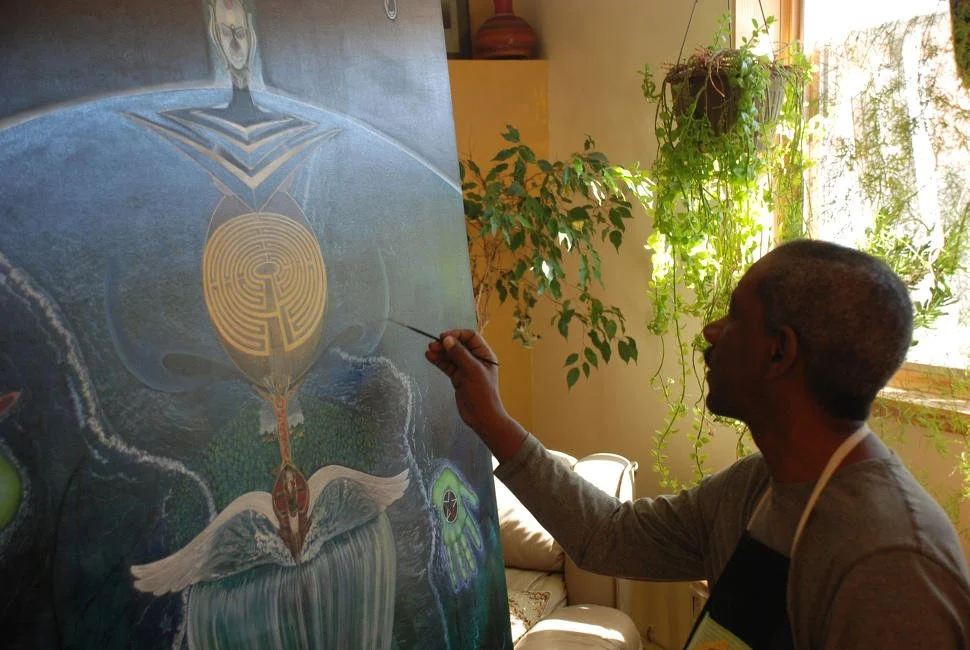
”Pete Jackson is both a gifted artist and a genuine visionary. He combines a unique painting skill with a keen perceptiveness of nature and spirituality. I treasure his work.”

Justin Talbot Zorn - Author, Meditation Teacher, Former Senior Policymaker and owner of a commissioned oil painting

The religion, spirituality, and symbolism in Pete Jackson’s art began within a southern family that founded a Pentecostal church. In early adulthood, along with spirituality, he pursued the healing arts through herbology, therapeutic bodywork, and both ancient Chinese and Brazilian martial arts. Pete’s visual capacity further increased when he apprenticed with a master surrealist painter and later began to use the consciousness-altering tea, Hoasca, also known as Ayahuasca.

“I heard before I drank (the tea) the first time that what I’d see would offer enough to work on for a lifetime. In that ceremony, the tea introduced me to the majesty of nature, and for 22 years, I traveled a mystical journey through a plant medicine believed to heal the spirit. In the early days, I didn’t believe it was possible to turn the vivid imagery I saw into paintings, but slowly a rhythmic force appeared that demanded to be realized as works of art.”  - Pete Jackson

The use of Hoasca was a defining moment for Pete, allowing him to quietly acknowledge himself as a visionary artist. However, he prioritized service to the church, as he had done most of his adult life, and decided to continue developing a body of work with elevated insights. Gradually, Pete moved up the hierarchy to become the first (and only) black man in the northern hemisphere to receive the title of Mestre in a church known in Brazil as a national treasure. In the position of Mestre, Pete was responsible for guiding others in their ceremonial journeys, which further propelled his own visionary work.

Always with an eye on being of service, Pete actively pursued energetic healing arts when his time in the church concluded. His visionary approach solidified when he became a practitioner of SourcePoint, a bodywork method that increases access to an underlying blueprint for human health. In addition to painting, he is now writing his soon-to-be-released autobiographical book titled Soldier For Peace (S4P), which embodies the production of art within the surrealist mission. Surrealism brings attention to reality, which, to Pete, embodies service. As Maurice Nadeau said in The History of Surrealism:

“Surrealism was not intended to transcend, but to penetrate reality.”

“I value visionary art, especially as a vehicle for expressing expanded spiritual possibilities. I want my work to captivate my audience in that way, and also reflect what is needed to make the vision a reality. That honors the lineage and purpose of the surrealist movement.” - Pete Jackson

Tama Brisbrane - Stockton Poet Laureate Emerita

“Almost as if he were painting with both hands, Pete Jackson blends history and surrealism as a visual invitation for contemplating metaphor and the unseen spiritual world. A fitting ability for an artist who continues to bear witness to the extreme and the uncanny.

Pete was born in 1956 into the peculiar southern oppression of the State of Virginia, with its broad-brush disenfranchisement of segregation, monochrome still life of Whites-only fountains and building entrances. He came of age in Washington, D.C., during the awakening of the black cultural movements of the 1960s-1980s, coincidentally living in an area that was almost exclusively reserved for wealthy white Americans. This positioned Pete to examine questions about fairness and life purpose, which led him to use his art to express the inner desire for answers and greater possibilities.

The real-life collage of being human, Black, male, visual and martial artist eventually led Pete to an appreciation of the surrealist art movement called Dada. His affinity for a creative expression embracing freedom, emotional connection, and political resistance grew into an avid artistic pursuit. The culmination happened in 1987 with an extremely rare opportunity to apprentice with master surrealist Abdul Mati Klarwein in Majorca, Spain.

A former student of legendary cubist Fernand Léger, a contemporary of fantastic realist painter Ernst Fuchs, and a good friend of Salvador Dalí, Mati attained legendary stature himself in the art and music worlds beginning in the 1970s. His paintings grace the most iconic album covers ever seen, including Miles Davis’ Bitches Brew, Santana’s Abraxas, and Earth, Wind & Fire’s Last Days And Time, among many, many others.

Jackson is the only African-American artist to have studied under Abdul Mati Klarwein. Over the course of a rigorous apprenticeship that became a lasting friendship, Mati introduced Pete to the techniques of the 15th- and 16th-century Flemish School of painting, which he employs to this day with a contemporary, distinctly cultural twist.

Mati also encouraged Pete to find and develop his unique voice. As Afro-Surrealism art continues to grow in practice and appreciation, here’s what Pete Jackson says about the diverse worlds his humanity, culture, artistic training, and perspective inhabit:”

“My art represents a perspective as a Black man with diverse interests, and as a result, my artistic voice explores the question, what is truth, and therefore births paintings that use symbolism, mythology, and touch on world religions, philosophy, and ancient cultural beliefs.” - Pete Jackson