The Universal Fountain
Oil on gesso canvas
Size: 48’ x 36″
Price: SOLD
Prints: currently not available
The Story:
The Universal Fountain is the first in a nine-painting series entitled We Are Our Ancestors. The painting is a play between the scientific and religious beliefs about the origin of The Universe. The face model is of a Polynesian Queen (thinned for artistic purposes). It honors one rich culture with an equally rich creation story. The use of the white pigment represents the light of creation emerging from its origin.
What Inspired This Piece:
Women’s rights have been a passion since childhood as the youngest in a household of five women, including my grandmother. The female figures in the painting represent what I observed as a child. The maternal figures emerge from one another, supporting one another and bringing life.
Symbols:
The Fish Birds represent life in the air and sea, but also all life waiting to materialize on earth.
The foot of the divine mother is about to make contact with a spiritual opening, much like one of the spheres of Earth’s atmosphere, and that point is a pool indicating water is life.
Layers of Meaning:
The Universal Fountain is itself the first of two layers. The story continues in The Ladder, as a diptych, or a second painting that carries the same theme. I selected the word "fountain" in the title because it best represents the source of water and life. The word universal is used because it is all-inclusive and embraces diversity.
Question from a viewer and the response:
What does the distant point represent?
This question unlocks the meaning of the painting. Science recognizes that distant point as the Big Bang, when space began to expand, giving rise to all life as we know it. I use poetic license to recognize it as the pivot from a genderless spiritual reality to the Divine Mother, with a simple message: all humans begin their journey through a mother.
Continuing the conversation:
What do you see?
What question do you have?
What inspired the painting:
The visionary imagery and inspiration came during the ceremonial use of the plant medicine commonly known as Ayahuasca. I saw a mandala of humanity in vivid colors unfolding like flower petals in a harmonious geometrical pattern and rhythm.
Symbols:
The Cross near the top of the painting does not represent a specific religion, but rather the belief that every human has their unique burden, or cross to bear.
The Scale represents what divine justice should be, and what man’s form of justice is striving to become.
Layers of Meaning:
The Ladder asks all of us whether we are responsible for each other. Can anything lasting be built without acknowledging that a power greater than humankind has the ultimate authority and sits as judge and jury?
Questions by a viewer and the response:
Why do many of the figures have no features, or symbols where their faces would be.
Why was the red, orange, and yellow color scheme chosen for this painting especially in the bottom mandala?
The Ladder
Oil on gesso canvas
Size: 54’ x 48″
Price: Currently NFS
Open-ended archival-quality prints: $179.00
The Story:
The Ladder (of Knowledge) was created as the second painting in a diptych with a contiguous theme. The first painting, The Universal Fountain, acknowledges the mother, and The Ladder represents the father and all humans, as having the DNA of both parents and ancestors.
Hero
Oil on gesso canvas
Size: 48″ x 48″
Price: SOLD
Prints are currently not available
The Story:
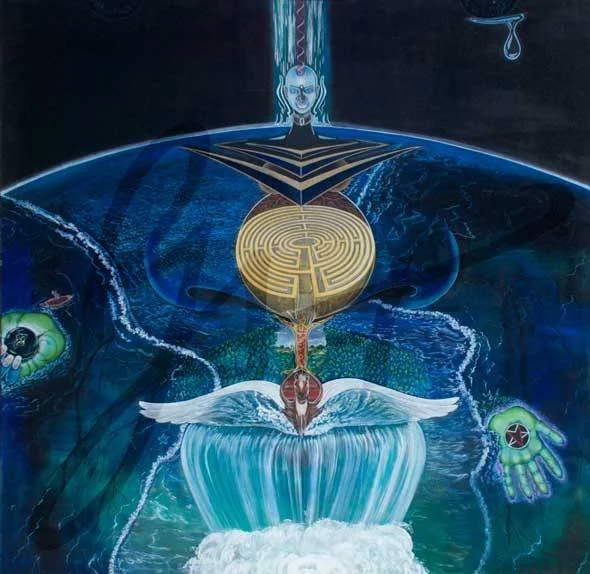
The third painting in the We Are Our Ancestors series is based on a mythological religious story. The Hero poetically acknowledges that all humans have ancestral archetypes such as the explorer, rebel, sage, and caregiver within. The hero archetype appears in many storylines and films today. It is an identifiable and relatable character who is often portrayed as making the greatest act to defeat evil in the darkest hour.
Introducing a hero so early in the series conveys the message that it lives inside everyone, to be called on early, often, and in a sustained way to bring change.
What Inspired this painting:
I’ve been in situations when I’ve needed help, and it came. I’ve also been in situations where, if I didn’t save myself, I would have been lost. At times, heroic actions are called for in order to survive and thrive.
The Symbols
A labyrinth appears for the first of three consecutive paintings in the We Are Our Ancestors series.
The Hero continues the inverted pentagrams (an adopted sign of evil) seen in The Ladder
The Ladder and The Hero refer to a north star, which is The Hero
Layers of Meaning
Symbolically, the duality of good and bad, with good sounding the horn of triumph, is what calls heroes to action. The challenges in life thus become paths to victory.
Question from a viewer and the response: The color scheme is very similar to that of the first painting in the series, The Universal Fountain. Is there a reason for this?
Absolutely!!! I refer back to that color palette from the first painting as the backdrop for the androgynous image, which is a divine God-Goddess figure. Here, I am presenting a reality that occurred around the globe. God has always been depicted in the image of the native people’s original beliefs. Whereas the Hero exists in every culture. Also, I use black, dark colors, and shades like a blank canvas. A white canvas is blank or light, whereas the dark canvas represents mystery, that which hasn’t revealed itself yet, and the space surrounding knowledge.
Continuing the Conversation:
Is it possible for you to call on your inner hero to bring change?
What do you see?
What questions do you have?
Sawubona:
Oil on gesso canvas
Size: 36″ x 48″
The Original is currently NFS
Open ended Archival Quality Prints: $179.00
Limited Edition Prints: contact artist
The Story:
The word Sawubona is Zulu and means I see you. I, includes ancestors therefore the meaning is: I (we ancestors) see you.
The response is: Yebo Sawubona, I (we) see you, if you and your ancestors equally see the person who addressed you with that word. In seeing each other, there is an acknowledgment of each other in the moment. The acknowledgment of seeing each other (and the ancestors) in history deepens the responsibility to assist each other in what is needed to be free to build a common future.
The painting speaks - I am a painting, yet I see you and you see me. My story is from people who used the oral tradition, and lived honoring nature. You or one of your ancestors did the same. Now that we see each other in our full past and present stories, how do we help each other regain our sovereignty?
What Inspired This Piece
I had been inspired by pre colonization visionary stories within indigenous cultures of the future time of, and eventual victory over, oppression.
I also felt inspired by the meaning of God’s guardianship as a nondenominational approach to a divine higher power.
Symbols: In relation to the question I utilize the Adrinkra symbols (on the lower right of the painting) are in the following order:
Slavery, Humility, Bravery, Emancipation, Reconciliation, God’s Guardianship
They become the line to follow.
Layers of Meaning: The Adinka symbols speak to the human drive to climb the ladder to a better life. If slavery is the lowest point, humility comes next, because it is needed to say, I see you. The greater humility is by seeing the self. The greatest is being in guardianship by making spiritual life more important than materialism.
In response to a viewer’s question:
Can you explain the patterns seen in the sky?
For the full answer there are several layers that need uncovering. An overview is that the village guard has the responsibility for the gift of premonition. It first allows him to see the architecture upon which all things are built. It allows him to see from the center of a labyrinth that will one day engulf his tribe. From that place he also sees the north star and the line to follow to be victorious.
Continuing the Conversation
Is it possible to see each other with the depth and practice of the true meaning of Sawubona?
What question do you have
“Nine Faces Of The Divine, And Her DoMinions”
Oil on gesso canvas
Size: 36×24
Price: Original currently NFS
Prints: Open-ended archival quality = $179.00
The Story:
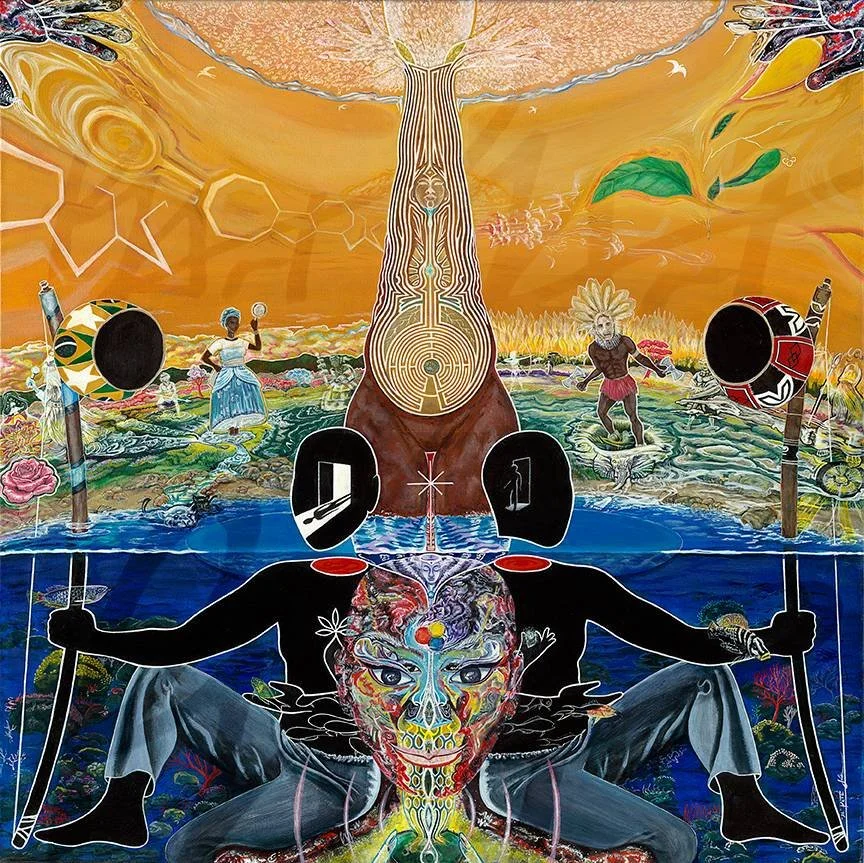
“Nine Faces of The Divine” is The Light who sees everything. She morphs to look directly at and through you; she looks down and up as a guide on all paths humans take, because She is The Dominion who speaks to the highest attributes in all people.
“And Her (Do)Minions” are the underlings of The Most Powerful, represented by a person with no neck separating the body and mind, who simultaneously faces the same and opposite directions, sees both the same and opposite perspectives with one door closed behind, and another open in front. Here is where courage is needed to release some of the past, elevate the consciousness, and step into a new experience.
What Inspired This Piece:
Nature is suffering from human irresponsibility. I wanted to create a visual representation of what can be lost, what can be found, and valued.
Symbols: A few are
The upper-right side features the fruit called Iboga. The plant is native to parts of Africa. One traditional use of Iboga was to induce a trance state to reveal a person's purpose in life.
The elephant is brought in because Iboga is also heavily consumed by elephants. This layer conveys that as we move from one place in life to another, our memory travels with us.
The central Samauma Tree, native to the Brazilian rainforest, is a mother figure. In the rainforest, this tree stands above all other trees. Her roots extend over vast distances along the rainforest floor, and in the dry season, swells of water are stored just inside the skin (bark) of the tree. At the driest point of the season, a loud thundering sound can be heard. This is when the nurturer, Samauma, gives birth to her water, feeding all the surrounding plants.
Layers of Meaning
Nine Faces is the Nurturer who births, feeds, embraces, and invites what can be found by stepping into the light, which represents a leap of faith into the spectrum of life’s colors of diversity, mystery and majesty.
In contrast, the main character or minion has no neck, which doesn’t allow the head to have the ability to see beyond the black-and-white of his conflict. Therefore, the colors represent opposition.
Question by a viewer and the response:
The figures in this painting are outlined in a light grey. Notably, most animals and background people in this series are painted in similar colors. Is this intentional, and if so, what is its meaning?
There are traditions that recognize a connection between the material and spiritual worlds. Among indigenous cultures in the Philippines, for example, during deep sleep, a person’s soul detaches from the body to roam the physical earth or travel to spiritual dimensions. I painted these images as translucent.
I also appreciate the concept of seeing things in what I call shades of grey. It frees anyone from viewing a topic in black-and-white or in polarized opposition.
Continuing the Conversation:
What do you see?
What questions do you have?
Fatima
Oil on special canvas preparation
NFS
Size 27” x 24”
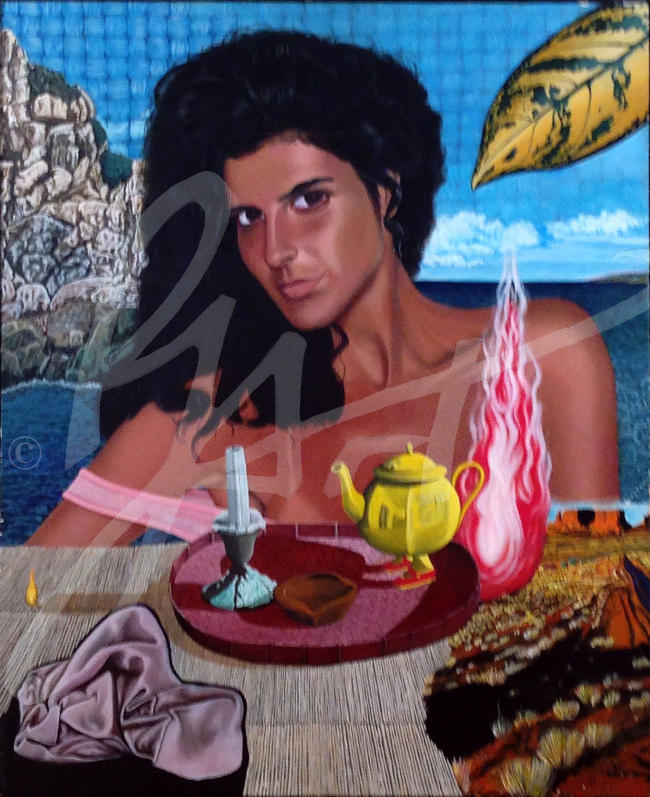
The child of a Brazilian playboy and Spanish actress, Fatima was my muse for an assignment during my stay in Majorca, Spain. Mati Klarwein asked me to embrace expanding reality as a surrealist motto.
Fatima was a friend and lover who came in like a temptress during a difficult personal time, and to honor the assignment, I played with how the temptress affects her surroundings.
Limited edition prints are available.
Self-Portrait - The Artist Journey
Oil on special canvas preparation
NFS
12'“ x 24”
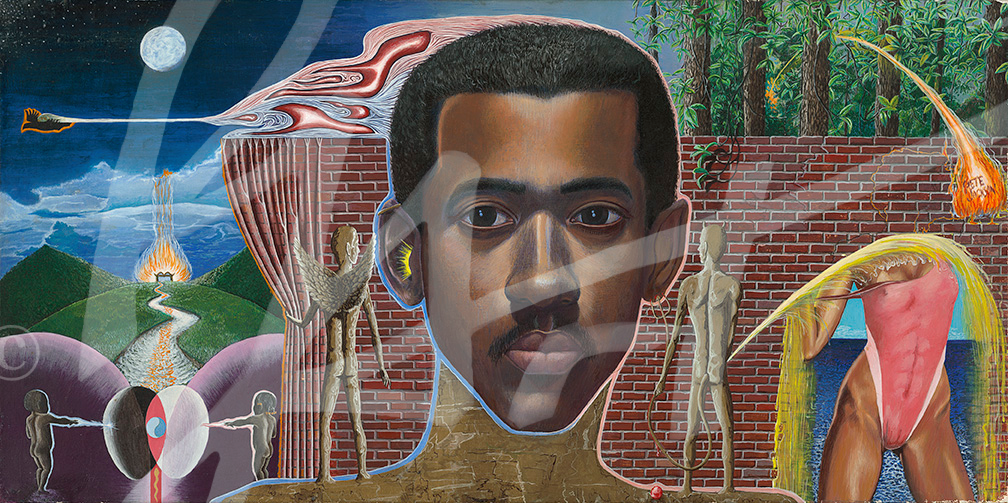
After Spain, I continued training in the new Flemish glazing technique, and, starting on the rooftop overlooking the UCLA campus, I continued to explore the temptress as anything that makes us question self-imposed limitations and boundaries versus those forced on us.
With limited space, I set out, looking in a mirror, beginning a self-portrait of the tragedy that gave the temptress a significant voice. My battle between good and evil is meant to reflect how the worst choice can be very appealing, while the best choice is filled with heartache and pain.
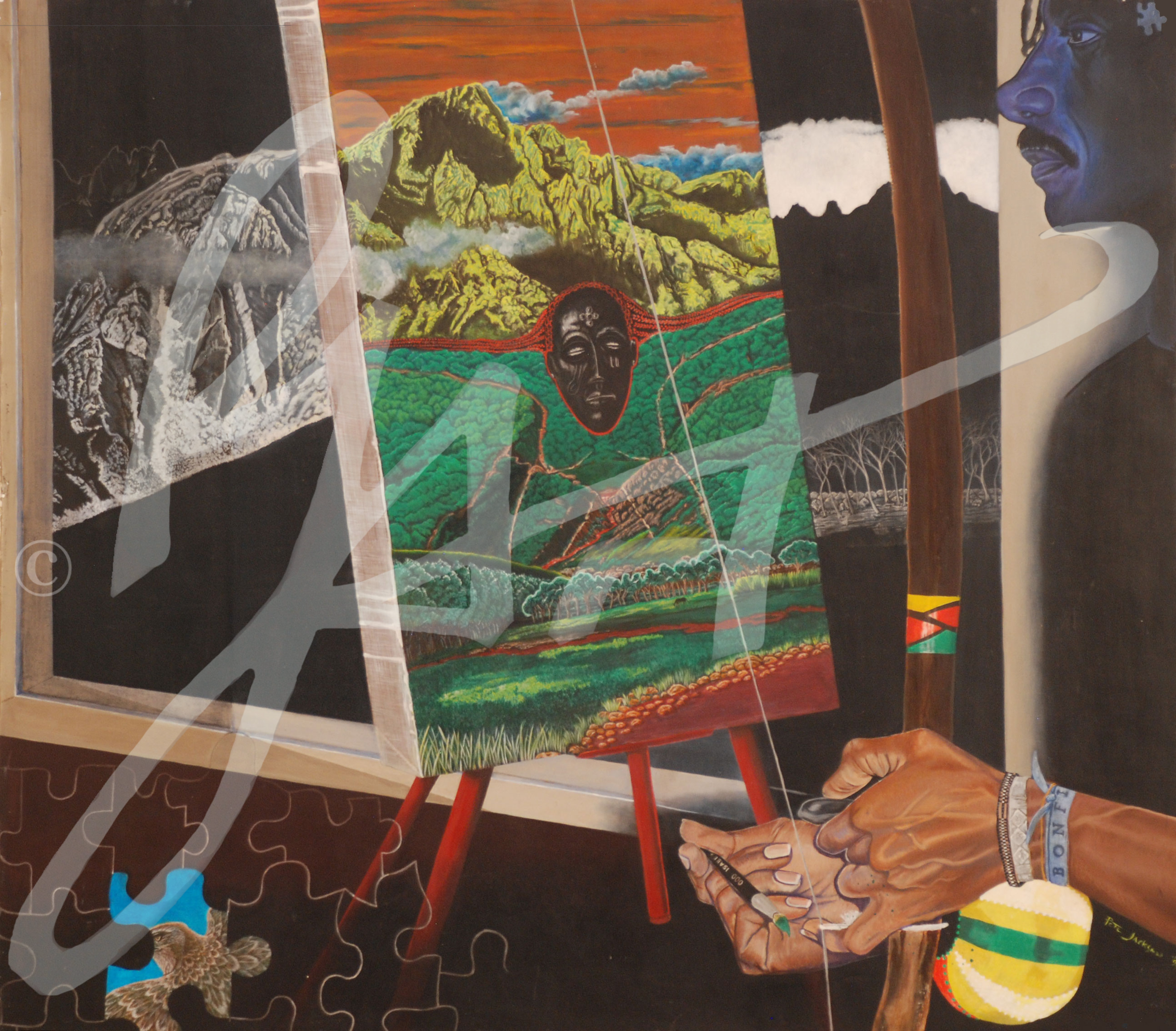
Berimbau (Self-Portrait)
Oil on special canvas preparation
NFS
Size: 23” x 26″
This self-portrait began in Malibu, CA, overlooking the ocean, and it pays homage to my tall, thin, wiry frame, which is why I was given the nickname Berimbau in Salvador, Bahia, Brazil. In the Candomblé ritual where I was named, I was reintroduced to the mysteries of nature.